 Stand out with an award-winning
Reputation damage doesn’t usually start with a viral post gone wrong or a PR crisis. It starts with silence. The candidates you hoped would apply never do, offer acceptance rates shrink, and recruiting timelines stretch longer than they used to.
At first, it’s easy to attribute these shifts to a tight labor market or increased competition. But sometimes the issue isn’t the talent pool. It’s perception.
In fact, 84% of job seekers consider an employer’s reputation before they ever apply, and 69% will reject offers from companies with poor reputations.
Key takeaways
- Employer reputation directly impacts hiring and retention.
- Reputation damage appears in HR metrics through early warning signs like declining candidate quality, more offer drop-offs, and rising recruiting costs.
- What starts as a hiring issue can lead to disengagement, burnout, and reduced performance.
- Candidates decide before they apply. Reviews, social proof, and peer feedback shape employer reputation early.
- Strong employer branding protects and rebuilds trust. Employee voice and third-party validation (like Top Workplaces) reinforce credibility.
Reputation matters more than you think
Today’s candidates research employers the same way consumers research products. They read reviews, scan LinkedIn conversations, and ask peers what it’s really like to work at your organization. Increasingly, AI is also shaping that perception—surfacing and summarizing employer reputation signals in ways that influence candidate decisions.
Want to see what candidates (and AI tools) are picking up on? Explore how AI judging your employer reputation.
By the time candidates decide whether to apply, they’ve already formed an opinion about your workplace. And that behavior has real consequences. Organizations with strong employer brands receive twice as many applications per job posting as those with negative reputations.
That’s why employer reputation matters more than many leaders realize. When your reputation takes a hit — whether from negative reviews, inconsistent employee experiences, or simply a lack of visible proof — the impact doesn’t stay confined to brand perception. It directly affects recruitment, retention, and ultimately business performance.
What reputation damage looks like in HR
For many organizations, the first signs of reputation damage appear in HR.
Say you’re managing a strong team and invest more in your hiring efforts, but the candidates you want most aren’t applying. Or say they enter the hiring process but drop out before the offer stage.
When reputation issues emerge, the consequences often surface in operational metrics:
- Fewer qualified candidates entering the pipeline means roles stay open longer.
- When organic interest declines, organizations often rely more on job boards, recruiters, and advertising, raising recruiting costs.
- Candidates may accept interviews but hesitate when it comes time to commit.
- Employees who feel uncertain about leadership or culture are more likely to explore other opportunities.
None of these signals occurs in isolation; they build gradually, creating friction in the hiring process and strain within existing teams. To get ahead, start by exploring employer reputation management strategies.
Reputation damage rarely announces itself clearly. It shows up as small inefficiencies that compound over time — until HR leaders find themselves working harder just to maintain the same hiring outcomes.
The ripple effect of employer reputation damage
When employer reputation weakens, the impact rarely stops with hiring. It ripples across the organization.
Unfufilled roles create hidden strain across the team
If fewer candidates apply, open roles remain unfilled longer. When teams operate understaffed, workloads increase, and employees feel the pressure. Over time, that pressure can lead to burnout, disengagement, and higher turnover. In fact, 82% of employees would leave their current role for a company with a stronger reputation. And the effects don’t stop there.
When employees disengage, a performance drop follows
Disengaged employees influence workplace morale. Lower morale affects productivity. Productivity challenges can begin to impact customer experience and operational efficiency. Suddenly, what started as a recruiting challenge becomes something more damaging.
Your employer reputation is your brand's reputation
Reputation also extends beyond employees and candidates. Customers, partners, and investors increasingly pay attention to how organizations treat their people. In fact, 64% of consumers have stopped purchasing from companies after learning about poor employee treatment. It goes to show: a negative perception of workplace culture can influence everything from brand loyalty to business partnerships.
In other words, when your employer reputation is damaged, your “cost per hire” doesn’t just go up. It doubles. You aren’t just paying for ads anymore. You’re paying a “risk premium” just to get candidates to the table.
How a strong employer brand protects you
The good news is that employer reputation can be managed proactively. When organizations actively listen to employees and measure their experiences, they gain valuable insights into what’s working and what needs attention. Those insights help leaders address potential issues before they become reputation risks.
Just as importantly, a strong employer brand provides visible proof of culture.
Instead of relying solely on internal messaging about company values or workplace priorities, organizations can showcase real data and authentic employee perspectives. Employee engagement surveys, culture insights, and verified recognition all contribute to a clearer picture of what your workplace is truly like.
If you’re ready to take action, explore how to build an employer reputation that actually recruits.
When candidates see that employee voices align with company messaging, trust builds quickly. And trust is the foundation of a resilient employer reputation.
How employer recognition builds credibility
One of the most effective ways organizations reinforce employer credibility is through third-party recognition. This is where Top Workplaces awards play a powerful role.
Unlike traditional recognition programs based on votes, judging panels — or worse, pay-to-play schemes — Top Workplaces awards are driven entirely by employee feedback through a research-backed survey developed and refined over decades. For HR leaders, that kind of validation carries real value. And it starts with understanding what your employees are actually experiencing.
When job seekers see that a company has earned a Top Workplaces award, it sends a clear signal: employees have spoken, and their voices reflect a strong workplace culture. That credibility helps strengthen recruiting efforts, reassure candidates, and build trust across the broader market.
It also provides organizations with tangible proof of culture — something far more persuasive than any employer branding campaign alone. If you’re exploring the broader impact, take a closer look at why recognition awards matter.
In a world where perception spreads quickly, that kind of credibility can make all the difference.
Take control of your employer reputation
The reality is this: the strongest reputations are the ones supported by real employee voices. The longer reputation issues go unaddressed, the more they impact hiring, retention, and performance.
Get the Employer Reputation Playbook and start building a stronger employer brand backed by real employee insight and credible proof.
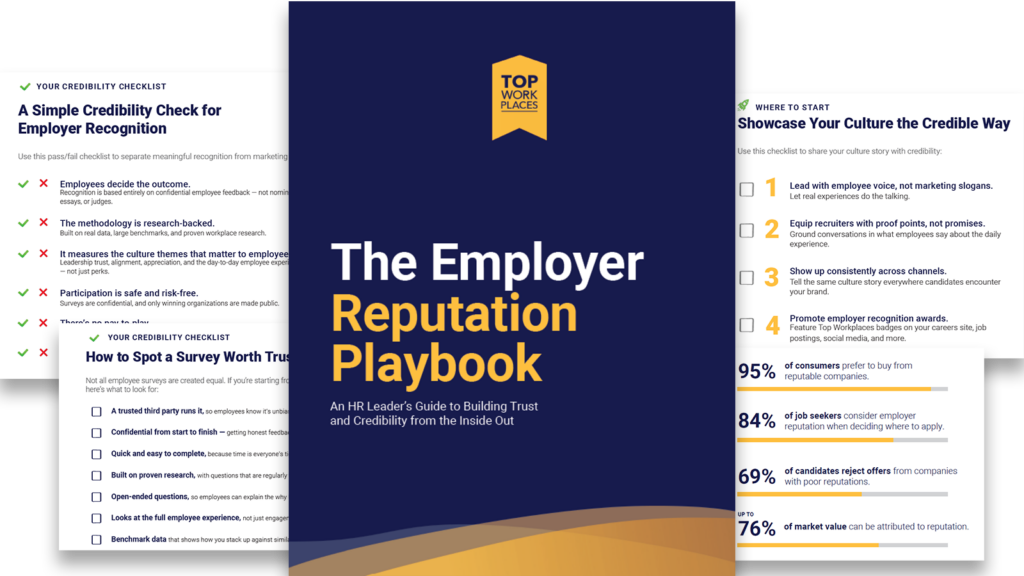
Start building an employer reputation that works for you, not against you.
Frequently asked questions
Employer reputation is how current employees, candidates, and the broader market perceive your workplace. It matters because it directly impacts your ability to attract talent, retain employees, and build trust with candidates before they ever apply.
Employer reputation plays a critical role in attracting talent. Candidates research companies before applying, and a negative employer reputation can lead to fewer applicants, lower offer acceptance rates, and longer hiring timelines. On the other hand, a strong employer brand increases candidate interest and improves recruitment outcomes.
The cost goes beyond recruiting. Organizations may face higher cost-per-hire, increased reliance on paid sourcing, and longer time-to-fill roles. Over time, it can also lead to higher turnover, lower employee engagement, and even impact customer trust and revenue.
Employer reputation management starts with understanding the employee experience. Organizations can improve their reputation by listening to employee feedback, addressing culture gaps, and showcasing authentic employee perspectives. Third-party recognition, such as Top Workplaces awards, also helps validate employer branding and build trust with candidates.
Early warning signs often appear in HR metrics, such as declining candidate quality, fewer applicants, increased offer rejections, longer time-to-fill roles, and rising recruiting costs. These signals typically build gradually rather than appearing all at once.