
 Stand out with an award-winning
There’s a quiet shift happening in how companies are evaluated. It’s not enough to rely on press releases or polished employer brand campaigns to shape perception.
Now, more than ever, it’s about employee reviews (on and offline), and what current and former employees say when no one from your leadership team is in the room.
And here’s the reality: your employer reputation already has a mic. The only question is whether you’re holding it — or whether someone else is.
Key takeaways
- Negative online reviews can directly impact your employer reputation.
- Managing your reputation requires ongoing monitoring, not a one-time effort.
- Employee feedback is the most credible source of insight into your workplace.
- Strong employer reputations attract talent and build trust with candidates.
- Employer recognition strengthens credibility and amplifies your brand.
You already have an employer reputation
Like it or not, your company has an employer reputation — even if you’ve never discussed employer reputation management.
It’s forming in:
- Online review sites like Glassdoor and Indeed
- Candidate group chats
- LinkedIn comments
- Industry Slack channels
- Exit interviews that get shared
And there’s a new source reporting on your employer reputation: AI. While these tools are streamlining workflows and supporting productivity, AI is also telling job seekers about your employer reputation.
That means the mic is always on. And when organizations aren’t actively shaping their employer brand with credible proof, people fill in the blanks themselves. If there are negative, unanswered reviews and no visible counterbalance, silence becomes a message. And silence rarely builds trust.
The implications of a bad employer reputation
Let’s address what many HR leaders quietly ask:
How much do employee reviews really matter?
The answer? More than we sometimes want to admit. Review platforms often skew toward dissatisfaction because people are more motivated to write when they feel frustrated. That doesn’t mean all negative reviews are fair, but it does mean they’re influential.
And here’s the part that stings if you’re an employer:
Candidates don’t assume reviews are perfectly accurate. They assume they’re revealing and credible, especially when there’s no visible counterproof.
According to industry data, the consequences of a bad employer reputation are rarely loud, but they have a significant impact:
1. Offer acceptance rates soften.
69% of candidates say they would reject an offer from an employer with a poor reputation. That means your reputation influences who applies and who accepts before you ever see a resume.
2. The candidate pool shrinks.
86% of job seekers say they would not apply to companies with a bad reputation. This shrinks your candidate pool, slowing hiring and making it more expensive.
3. Talent comes at a higher price.
Companies with a poor employer brand pay at least 10% more per hire to attract talent compared to those with strong reputations.
Employer reputation management goes beyond damage control
Responding to negative employee reviews can be controversial because it is one of the most visible aspects of your employer brand. To respond or not to respond? Which is more professional? We’re here to put the debate to rest. The truth?
Respond. It shows awareness and is better than silence. But keep in mind, responding isn’t the same as rebuilding employer trust.
When organizations rely solely on point-by-point rebuttals, it can come off as defensive, even if the intention is transparency. And defensive messaging rarely strengthens employer brand credibility.
A handful of thoughtful responses won’t outweigh a consistent narrative of employee frustration, and a carefully worded statement doesn’t compete with dozens of employee voices.
- Why this matters: Managing your employer reputation isn’t about managing comments. In actuality, it’s about managing proof.
A credible employer brand isn't built on claims
If your website and careers pages include statements like these:
- “We prioritize your development.”
- “Our employees are our greatest asset.”
- “We listen to employees.”
Candidates don’t stop to admire your messaging. They ask a much simpler question: “Can anyone confirm these claims?”
That’s the moment when employer brand promises either gain credibility — or start to unravel.
Third-party, employee-driven validation changes the game. When real employee voices are visible, data-backed, and externally verified, uncertainty gets replaced with evidence.
That’s the credibility gap most organizations underestimate. Polished messaging can introduce your culture. But only employees can validate it.
Alignment is what today’s job seekers are looking for. They don’t expect perfection. They expect consistency. When employee voices align with your brand’s promises, trust builds faster — and skepticism fades.
So let’s talk about how you can build your employer reputation the credible way.
Turning employee voices into reputation capital
Employee feedback is often treated as an internal diagnostic tool. But it’s more than that. When used strategically, it’s a powerful way to showcase your unique employer brand ― and earn credible employer recognition at the same time. That’s not just storytelling. It’s real employer reputation capital.
Here’s how to do it:
1. Lead with voice of employee to tell an authentic story
An employer can describe its culture all day long, but when recognition is driven by anonymous employee feedback and validated externally, it lands differently. It feels less like marketing and more like measurement. And that distinction matters to today’s candidates.
Instead of relying on employer-written messaging, use confidential survey insights to showcase what employees experience day in and day out:
- Highlight meaningful employee engagement scores and culture strengths.
- Share word clouds that illustrate how employees describe the workplace.
- Feature anonymous employee survey comments reflect the lived experience.
When those elements appear on careers pages, in job postings, on social media, and in recruiting materials, your culture stops feeling abstract and becomes tangible.
2. Earn credible awards that signal culture trust
Employer recognition, backed by employee data (such as Top Workplaces awards), serves as a shorthand for employee satisfaction. It tells candidates:
“Employees said this, and a credible third party verified it.”
Third-party validation accelerates trust in a way internal messaging simply can’t. It also helps rebuild employer trust if your organization has experienced a reputational strain. Plus, awards grounded in employee feedback provide visible proof that your culture is top-of-the-line — and give candidates a reason to believe it.
Here’s what folks really hear when they see credible employer recognition:
- “Employees feel heard.”
- “Leadership is accountable.”
- “There’s data behind the claims.”
And increasingly, customers are paying attention too. Employer brand and corporate brand are no longer separate conversations. Reputation travels. Make sure you’re on the right side.
Get The Employer Reputation Playbook free
If you’re reading this, you’re likely already thinking strategically about employer reputation. Strong employer reputation management starts with listening to employee feedback and translating it into visible employer recognition.
The next step after listening is developing a clearer plan.
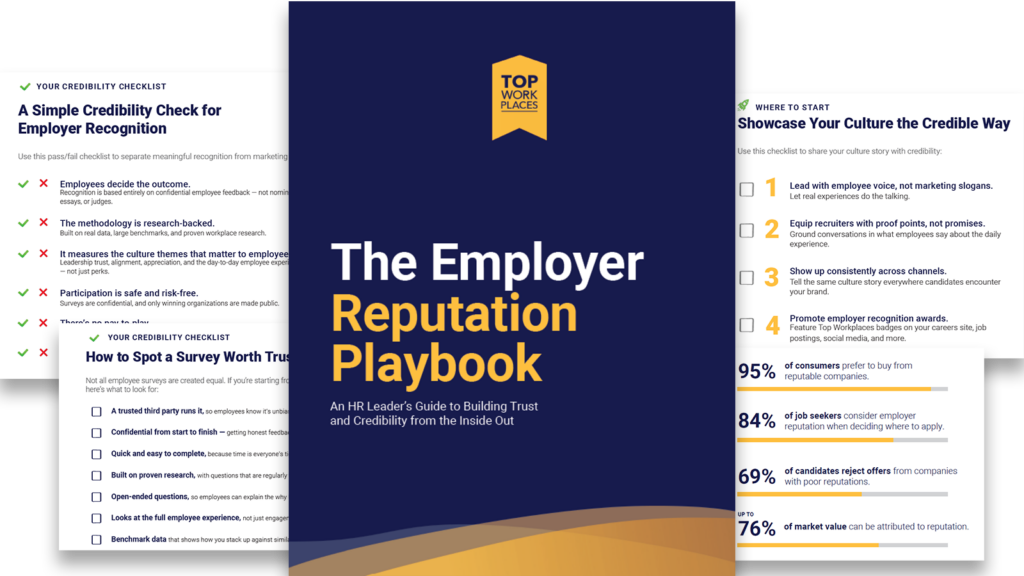
The Employer Reputation Playbook will show you how to:
- Diagnose employer reputation risk before it impacts hiring and engagement.
- Use employee feedback as a culture compass and an external proof point.
- Turn employer recognition into a long-term brand asset.
- Replace uncertainty — internally and externally — with credible evidence.
Effective employer reputation management turns employee feedback and employer recognition into long-term brand credibility. You don’t need to control every narrative, but you do need visible proof that reflects the reality of your workplace.
Your employer reputation has a mic. Make sure it’s amplifying the right message.
Frequently asked questions
Employer reputation management is the process of monitoring, influencing, and improving how your organization is perceived as a place to work.
Candidates research employers before applying, so a strong reputation helps attract talent, while a weak one can drive candidates away.
Employee feedback provides real-time insight into workplace culture and is one of the most trusted signals for job seekers evaluating an employer.
A positive reputation increases candidate trust, improves application rates, and helps convert top talent more efficiently.
Employer branding is what a company says about itself, while reputation management focuses on how others actually perceive and validate those claims.